The post Facing Our Powerful Potential appeared first on Eudaimonia Center.
]]>
When we face our challenges head on and from our center, we discover and are able to take a stand in our place in the Universe. Facing our potential, we are called to enter a journey of discovery and not surprisingly, at the center our, Source and Oneness gives us the strength to manifest the highest possible outcome in the experience we find ourselves in.
There is duality in this potential, as there is in all things, at the same time we are called to face the dragon or unleashed power of others, while standing up to things and people, who are not living from their center. Some have become disruptive agents that dishearten all they touch, and we are charged to stand in our center in order to not be overtaken by this energy. Perhaps it is a function of the Universe to balance, that causes us to face these sometimes troubling and confusing experiences.
On a deeper level, perhaps facing our potential is the call to summon our best qualities in order to face some one, some thing, some force that is challenging. And perhaps this one thing, one force, or someone, is not always bad or dangerous; it is simply that life often demands that we face things in order to transform…. a process we often miss or tend to resist.
If persistent, facing our challenges can transform us into our truest self.
To “face” does not mean to resist or to defeat, but to encounter honestly. And to “be” does not mean to retreat from this world, but to merge with it from a centered place of strength.
Marin Luther King Jr. revealed an inextricable link between power and love:
“Power when properly understood is nothing but the ability to achieve purpose. And one of the great problems of history is that the concepts of love and power have usually been contrasted as opposites … polar opposites … so that love is identified with a resignation of power, and power with a denial of love. We’ve got to get this thing right. What is needed is a realization that power without love is reckless and abusive, and love without power is sentimental and anemic. Power at its best is love implementing the demands of justice, and justice at its best is power correcting everything that stands against love. It is precisely this collision of immoral power with powerless morality which constitutes the major crisis of our time.”
Perhaps, the question has always been: How do we define these elements? Is strength the art of authority, of achieving domination over situations and others, as rulers throughout history have shown us? Or is it the strength of the art of embrace, of surrendering to the power of love and truth rising up within us?
We all carry the seed of each element; the power of authority and the power of embrace. May we all use our power for our optimal potential to live as illuminated beings.
…Blessings and love, Christina
The post Facing Our Powerful Potential appeared first on Eudaimonia Center.
]]>The post Our Christmas Wish ….. Unconditional Love for All appeared first on Eudaimonia Center.
]]>Simply stated, unconditional love is an unlimited way of being. We are without any limit to our thoughts and feelings in life and can create any reality we choose to focus our attention upon. There are infinite imaginative possibilities when we allow the freedom to go beyond our perceived limits. If we can dream it, we can build it. Life, through unconditional love, is a wondrous adventure that excites the very core of our being and lights our path with delight.
Defining Unconditional Love
Unconditional love is an unlimited way of being. This definition doesn’t necessarily speak to the typical expected response or popular collective understanding of most cultures. Instead it reveals something more important – the individual potential that resides within each of us every moment. It merely asks that we approach each moment with clarity and right perspective and recognize the vast unlimited possibilities to choose a new way of thinking and feeling.
Such a sense of profound love comes when we first forgive and accept ourselves for all our limiting beliefs, mistakes, judgments and misunderstandings and apply the “unconditional” to us personally. We recognize our self-worth, value our talents, and allow ourselves to be who we are rather than what we think others wish us to be. In turn, we naturally understand those around us and extend our helping hand without condition, judgment or expectation. We see ourselves in the reflection of another and know that everyone deserves to love and be loved without condition.
By embracing the present moment with openness, we realize and know we have the solutions and answers already within us. We begin building a reality that is based on love, wisdom and power in perfect balance. For each step we take personally, we impact the world with this amazing energy of love.
Unconditional love turns hope into knowing in a collective reality that is often seen as hopeless or seemingly impossible to overcome. When we know something is possible, we empower this to manifest with our very being. So know we know that we are loved and loving and see how the world responds to our light and knowing. Notice how our peace and strength is sought out by others and how the limitless love we have to share is the love we receive in return.
Why Unconditional Love?
When we allow ourselves to understand the impact our actions have not only on ourselves but the planet we live on, we realize the necessity to take loving action. We each have the power to correct conditions within as well as to affect the world we live in.
When we practice constant acts of kindness, we bring kindness upon this planet. Forgiveness is the easiest and most powerful act of kindness we can make. Both for our selves and for others, this activity promotes unity, harmony and oneness that transmutes the old into the new.
This magnificent planet is filled with opportunities to experience love, respect, peace and joy. When we, as individuals, realize our potential to love unconditionally, we transform ourselves and the planet at the same time. Such is the power we wield every moment of every day. The choice is ours to create a world of joy and happiness, love and goodwill.
Living with Love
The power of love is held within each of us every moment. This wondrous energy is available merely by our use and conscious recognition. When we choose to love one another, we transcend the lower personality perceptions and rise to a higher truth. We recognize our oneness, wholeness and interconnectedness.
This is not a conditional love or the type of love one may try to use to earn favors or expect validation, rather this is a universal and unconditional love that recognizes the beauty in life every moment. It is of a higher nature. It is a natural expression that does not expect an outcome. It is giving just for the sake of giving.
It is in the sharing and giving of love to others that we receive the same that we give. Give love and surely, we will experience love itself. Express love to the world around us and the world will reflect back to us the power of love.
Choose Love
Unconditional love requires us to remain open to receive this divine guidance from a higher realm, the Christ light and the Holy Spirit. And as we are guided the mystery of life unfolds before us and we follow a path of light, wonder and mystery. This sacred light contains all the energy we need to live a conscious, happy and intentional life.
At this level we have an absolute knowing that we have all that we need and that we are blessed in love that fulfills our life. There is no craving, no desire, no anger no fear. It is the eternal now where we experience a complete oneness with all of life. This bliss is the inner space where we are untouched by the mundane and still carry out our daily tasks, cultivating love, compassion and truth as we are co-creating our lives in the reality of unconditional love and the reality of wholeness.
Loving is a choice we can make every moment. When we are clear and receptive to our own higher, loving nature, we can then direct this love to people and places around us. Our peace becomes the peace for others. Our love becomes the love other people feel.
Let us be the angels we are and choose to live freely and joyfully; in doing so, we make this a better world to live and love in. Let us live a life of compassion and unconditional love, and then the world will indeed become a garden where all kinds of flowers can bloom and grow. May love, light, joy and happiness be with you this Holiday Season .
…. Blessings and Love, Christina and Dimitri
The post Our Christmas Wish ….. Unconditional Love for All appeared first on Eudaimonia Center.
]]>The post Reclaiming the FUN this Holiday Season appeared first on Eudaimonia Center.
]]>Since all these important things need to be done, as they are the substance of your life (this is not a dress rehearsal), doesn’t it make sense to find ways to have more fun while doing each functional task? Good planning can be a lot of fun to plan but remember … Worrying is not planning! Worrying about the outcome of our plans takes us away from enjoying activities in the present. A good plan is like an anchor in the storm of worry. If you get caught in worry, come back to your plans and take action Now.
We are more likely to experience fun when we are fully present to the smells, tastes, sounds, sights, and feelings of the holiday season. It’s a matter of focus and to experience more joy in the moment, simply shift your focus and pay attention to all these pleasant experiences. Take this a step further and begin to expect, seek, and create more pleasant moments looking for opportunities to have fun along the way.
How do we put the fun back in your Holiday Season?
When is the last time you really had fun—the last time you just let yourself go and had a good time? When did you last forget about all your daily responsibilities and live in the moment? If it’s been too long, one of these assumptions about fun may be holding you back.
Stop worrying what other people will think. You are not a mind reader and other people don’t think about you nearly as much as you think they do. Be your authentic self because those who matter appreciate you.
It’s true: Some of the best things in life are free…. You don’t need to spend a lot of money to buy a lot of stuff, nor do you need to go on a pricey vacation to have fun. It’s more about just being in the moment with the people you care about.
There is always time to have fun. There is always time to have fun no matter how little time you think you have—you can make the time. Fun is found in the little moments; you don’t need to carve out your whole day, simply do something you enjoy, just for the fun of it.
Do you really need to plan everything? Perhaps the most fun can be found in spontaneous unplanned moments by simply allowing things to happen naturally. Let yourself experience spur-of-the-moment trips and last-minute get-together. Be in the present moment.
Conditions do not have to be perfect and they seldom are! .Many fun moments occur when things go unexpectedly awry. Allow yourself to be imperfect and enjoy the imperfections of life. Humans are imperfect creatures, after all, and you’re one of them. Telling yourself, “I’ll have fun when…” is counterproductive; have fun now: There’s no time like the present.
If you think it has to be big and spectacular, here’s a News flash: Every day is not a holiday or parades, and parties. If you think real fun only happens at big events, you’re depriving yourself of some good times. Fun is what you make it. It doesn’t need to be spectacular, by any means and more often it is found in smaller five or ten-minute increments that create wonderful lasting memories. Holidays are Great Opportunities for FUN.
Benefits of Being Creative and Playful
It’s never too late to develop your playful, humorous side. If you find yourself limiting your playfulness, it’s possible that you’re self-conscious and concerned about how you’ll look and sound to others when attempting to be lighthearted. Play helps:
Relieve stress. Play is fun and can trigger the release of endorphins, the body’s natural feel-good chemicals. Endorphins promote an overall sense of well-being and can even temporarily relieve pain.
Improve brain function. Playing chess, completing puzzles, or pursuing other fun activities that challenge the brain can help prevent memory problems and improve brain function. The social interaction of playing with family and friends can also help ward off stress and depression.
Stimulate the mind and boost creativity. Young children often learn best when they are playing—a principle that applies to adults, as well. You’ll learn a new task better when it’s fun and you’re in a relaxed and playful mood. Play can also stimulate your imagination, helping you adapt and solve problems.
Improve relationships and your connection to others. Sharing laughter and fun can foster empathy, compassion, trust, and intimacy with others. Play doesn’t have to include a specific activity; it can also be a state of mind. Developing a playful nature can help you loosen up in stressful situations, break the ice with strangers, make new friends, and form new business relationships.
Keep you feeling young and energetic. In the words of George Bernard Shaw, “We don’t stop playing because we grow old; we grow old because we stop playing.” Play can boost your energy and vitality and even improve your resistance to disease, helping you function at your best.
Remember what the holidays are really about
It’s about – spending quality time with family, friends and loved ones. It’s about giving love and joy to others. Watch your expectation; make sure they are realistic. We try for perfection during the holidays and we tend to forget what the holidays are really about. Remind yourself that the holidays are about being close to your loved ones while everything else comes second.
This Holiday give yourself permission to be creative and spontaneous. Set aside your inhibitions and try something fun, something you haven’t done since you were a kid, perhaps. This holiday Season as you are gathered with family and friends and in the spirit of Holiday Fun, go once round the table asking others if they have a fun story feel free to share it!
… Love and blessings, Christina
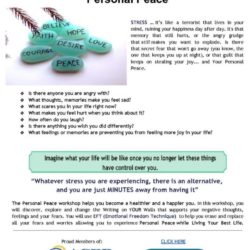
More Content on EFT and Personal Peace

The post Reclaiming the FUN this Holiday Season appeared first on Eudaimonia Center.
]]>The post Genes are Not Set in Concrete at Birth and Can be Modified appeared first on Eudaimonia Center.
]]>Epigenetic research has established that DNA blueprints passed down through genes are not set in concrete at birth and can be modified. Our genes are continually being modified in response to our life experiences and how we perceive them. Our cells respond to our thoughts and perceptions, and our perceptions shape our biology. Each of the 75 trillion cells in the human body has a digestive, respiratory, excretory, endocrine, nervous, reproductive, and immune system. Individual cells have intelligence and memory.
The Mind-Body Connection in our DNA
Researchers at Duke University recently concluded a long-term study on the effects of violence on children’s DNA. The study, reported in the journal Molecular Psychiatry, found that children who had experienced violence had shorter genetic structures, called telomeres, than children who did not experience violence. These children experienced physical abuse by an adult, were bullied frequently, or had witnessed domestic violence between the ages of 5 and 10. The children who were exposed to violence had wear-and-tear to their DNA similar to that seen in aging. This might explain why they face an increased risk of mental and physical disorders in adulthood. It is estimated that children who had experienced multiple types of violence had their lives reduced by 7 to 10 years.
Our mind sends out impulses of intelligence and our DNA receives it. We are continually conversing with our DNA. Our emotions influence which genes are expressed and which ones are not. Every thought and emotion we experience sends a message which impacts each cell in our bodies and is registered in the memory of each cell. This cell memory imprints automatically and unconsciously and is later referred back to continually as this has our belief system.
Our beliefs alter our biology at every moment. When we are feeling angry, isolated and tense our DNA retracts into tight coils. When we feel uplifted and open our DNA expands into graceful spirals. Our perceptions of the environment and resulting beliefs actually determine the expression of our genes and behavior. By adjusting our perceptions, we can adjust our behavior.
It is our early experiences with caregivers that shape a child’s core beliefs about self, others, and life in general. Experiences of the baby and young child are encoded in the brain. Emotional experiences of nurturance and protection are encoded in the brain’s limbic area, the emotional center. Over time, repeated encoded experiences become internal working models – core beliefs about self, self in relation to others, and the world in general. These core beliefs become the lens through which children (and later adults) view themselves and others, especially authority and attachment figures. Core beliefs serve to interpret the present and anticipate the future.
The core beliefs of children who have experienced secure in the early years will enable them to feel a safe and secure attachment to others and life feels worth living. Whereas the core beliefs of emotionally neglected children tend to have compromised attachments that not only lead to emotional and social problems, but also result in biochemical consequences in the developing brain. Infants raised without loving touch and security have abnormally high levels of stress hormones, which can impair the growth and development of their brains and bodies.
Attachment is the deep and enduring connection established between a child and caregiver in the first several years of life. It profoundly influences every aspect of the human condition — mind, body, emotions, relationships and morality.
The neurobiological consequences of emotional neglect can leave children behaviorally disordered, depressed, apathetic, slow to learn, and prone to chronic illness. Compared to securely attached children, attachment disordered children are significantly more likely to be aggressive, disruptive and antisocial. Teenage boys, for example, who have experienced attachment difficulties early in life, are three times more likely to commit violent crimes.
Disruption of attachment during the crucial first three years can lead to what has been called “affectionless psychopathy”, the inability to form meaningful emotional relationships, coupled with chronic anger, poor impulse control, and a lack of remorse. Children who experience interpersonal trauma feel rejection, pain, fear and anger.
Writing the Code of Early Experiences
The baby’s brain is an “open-loop system,” dependent on the parent’s or caregiver’s support, security and emotional connection for healthy growth and functioning.
Early attachment experiences shape the brain’s structure, chemistry and genetic expression in the following ways:
- They activate neuronal firing, creating synaptic connections between neurons (“what fires together wires together”).
- Biochemicals are triggered and released. Secure attachment between baby and parent triggers the release of Dopamine (pleasure, closeness, motivation), Endorphins (reduces pain, enhances calmness and contentment), Serotonin (stress reduction) and Oxytocin (fosters maternal behavior and bonding).
- Early experiences of secure or insecure attachment are programmed into the implicit memory systems (preverbal and unconscious) of the brain’s limbic system and become mindsets and expectations that guide subsequent behavior. For example, you may fear intimacy and dependency as an adult because of experiencing abandonment and betrayal as a child.
Change is Possible
Although, early experiences are a significant indicator of attachment patterns that an individual often carries with them into adulthood. That, however, doesn’t have to mean that a child who has experienced abandonment, lack of love, trauma or abuse in the early years must struggle with the inability to form loving and secure relationships later on.
Many studies on therapy outcome, reveal that the quality of the therapeutic relationship is the primary factor associated with positive results – more important than any theory or methods used. The experience of a healing relationship, whether it is between a therapist and client, or parent and child, is the most change-producing factor. Positive change requires a relationship in which people experience trust, safety, empathy, support, healthy boundaries, and “limbic resonance” (emotional and mental attunement).
Set yourself Free … Change is Possible. Healing is possible through with effective experiential interventions, unhealthy and damaging attachment patterns can be transformed. There are new techniques for healing using effective Energy Psychology, such as EFT. You can rapidly initiate change, any unhealthy and damaging attachment patterns can be transformed.
…. Blessings and love, Christina
More Content on Epigenetics
The post Genes are Not Set in Concrete at Birth and Can be Modified appeared first on Eudaimonia Center.
]]>The post SO MANY QUESTIONS … appeared first on Eudaimonia Center.
]]>As Socrates said, “A life without enquiry is not worth living.” A true scientist or searcher of the truth seeks continuously to uncover ever deeper answers in an endless attempt to explain the phenomena of this dimension of time, space, matter and energy. A seeker of what’s true seeks to free himself from illusions of the surface events and discover, not only the cause, but even more importantly, the purpose behind them. We are all scientists and seekers of truth. Some of us have simply fallen asleep at the job.
Are we controlled by our brains, DNA and childhood programming?
- If we are trapped in our brains, DNA and the results of our childhood experiences, then is there any reason to make any effort to change or improve ourselves?
- If I can only understand what my brain dictates, they what can account for the evolution of knowledge?
- If we are the result of some chance chemical reaction, then is there any reason ask any questions?
Can we affect the direction of our lives?
- Can we alter the functioning of our DNA?
- Can we get free from Childhood programming?
- Are we able to affect our bodies and minds with our thoughts?
- Are we able to affect our future and efforts with our thoughts?
- Can we affect the world around us with our thoughts?
- Can we help others with our thoughts and intentions?
How does Placebo Work?
If our brain and not our mind is creating reality, how is it that when a person believes that a substance or procedure is helping him, he gets well even when that substance or procedure has no therapeutic elements (Such a sugar pill or fake operation or fake acupuncture.) These are not affecting the brain. They are affecting the mind. See the very impressive story of Dr. Bruno Klopfer and Mr. Wright exhibiting both “placebo” and “nocebo” where Mr. Wright creates both healing and illness by his beliefs.
http://www.virsmai.com/blog/placebo-effect
If the mind is limited to the brain how is it that according to the new science of epigenetics, that the functioning of our DNA can change due to environmental changes including our thoughts and emotions. https://www.brucelipton.com
How is it that studies in epigenetics now show that changes in the environment, emotions and beliefs can change the functioning of our DNA? https://www.brucelipton.com/books/biology-of-belief
The current perception based on “new science” is that although consciousness / mind expresses itself through the brain, it is not created by the brain and it is not limited to it and can have non-local activity and affect on the world.
In the last decade epigenetics research has shown that our DNA that we inherit is not determined totally by our birth. Our genes are not our fate! Environmental factors such as food, anxiety and emotions can alter the data in our genes without changing their basic structure. Some of those changes can be passed on to our offspring. We are the managers of our biology. We have the ability to alter the functioning of our biology and thus our fate.
“A human being is part of the whole, called by us ‘universe,’ a part limited in time and space. He experiences his thoughts and feelings as something separate from the rest – a kind of optical delusion of his consciousness…” This delusion is a kind of prison for us, restricting us to our personal decisions and to affection for a few persons nearest us… “Our task must be to free ourselves from this prison by widening our circle of compassion to embrace all living creatures and the whole of nature in its beauty.” Albert Einstein, Nobel physicist 1879-1955
Our ability to change the functioning of our DNA – epigenetics. Of course our mind and consciousness are affected by our brain and its various centers which when stimulated by chemicals, hormones, DNA functioning, heat, cold, chemicals in the air or electronic stimulation create various mental and emotional states. This is obvious and cannot be refuted. But that does not mean that the brain is the cause of consciousness. It simply means that when consciousness is expressing itself through the brain that it is affected by the brain.
Imagine that you have a car and you get into it. You exist before you get into the car. While in the car you are very much limited by and affected by the car, its abilities, its problems, its movement, temperature, smoke, fumes, heavy vibrations, electrical problems of the car etc. You are very much affected by your car, when you are in it.
Because you have a cell phone your action is not limited to the car. You can have an effect at a distance. Because you are not your car, when you get out, you continue to exist. There is no proof that you do not exist when you get out of your car and 95 % of the people believe that you do exist. All major religions and great thinkers such as Socrates, Plato, Pythagoras all agree that you do continue to exist when you get out of the car.
So for me, we as consciousness exist before entering the body and are very much affected by the state of the body and brain while in it.
How we think can change how the brain, body and even DNA function and also our intentions and will power can change the functioning of the brain, DNA and body. We can also affect the people, events and world around us. We do have free will to change the direction of our car. Otherwise life does not have much meaning.
Our “car” may have very much movement (mass x speed) toward a specific event because of our DNA and childhood experiences. But we can get a hold of the wheel and by changing how we think and act change where the car is going.
Because the state of the body and brain very much affect how we feel and think, it is extremely important to care for the body and brain with proper food, daily exercise, breathing techniques, relaxation techniques, getting enough rest and positive thinking on order to avoid possible negative effects of a malfunctioning body and / or brain on our emotions and thoughts.
Moving forward, we don’t have to lie to our self and tell our self that we have this amazing mind/body. All you have to say is I’m healthy. In that statement, you express gratitude and you express that you grateful for your strength. Becoming limitless means seeing the endless potential of perspectives. We simply learn to live a healthier life style and integrate the concepts that progress towards a successful and ultimately a longer and healthier life.
…. Blessings and Love, Christina
More Content on EFT and Personal Peace
The post SO MANY QUESTIONS … appeared first on Eudaimonia Center.
]]>The post The Brain Is Not Hard Wired appeared first on Eudaimonia Center.
]]>The brain is not hard wired. In fact, if there are no experiences that activate the neurons and their synaptic connections, they will be lost. In other words, if we are no longer using a specific neural pathway then the brain considers it no longer useful and sets about eliminating that particular neuropathy way.
For example, the more you run a neural-circuit in your brain, the stronger that circuit becomes. “Practice makes Perfect… right?”. The more you practice piano, or speaking a language, or juggling, the stronger those circuits get. Scientists have known this for years. However, there is another part of the truth: In order to learn something, even more important than practicing is the ability to unlearn, or to break down the old neural connections. This is called “synaptic pruning”.
Synaptic Pruning…. Meet Your Inner Gardner
“Neurons that Fire Together Wire Together.”
Your brain is like a garden, except instead of growing flowers, fruits, and vegetables, you grow synaptic connections between neurons. These are the connections that neurotransmitters like dopamine, serotonin, and others travel across. Your brain actually acts like a gardener. It removes any waste, by pulling up weeds, killing pests, raking up dead leaves. In other words, it prunes your synaptic connections. The question is, how does the brain know which ones to prune?
Researchers are just starting to unravel this mystery, but what they do know is the synaptic connections that get used less get marked by a protein. When other cells detect that mark, they bond to the protein and destroy or prune the synapse. Your brain makes the physical space for you to build new and stronger connections so you can learn more.
The great news is, you actually instruct the gardener in your brains by what you focus on. For example, if you focus on something you don’t want, you are actually strengthening that particular synaptic connection. On the other hand, if you ignore that negative thought and give more attention to something you do want, the inner gardener will dismantle and tear down that old connection making way for a new one. This is what the science and methodologies of Energy Psychology is all about.
What is Energy Psychology?
The field of Energy Psychology (EP) is “a major breakthrough” and “the medicine of the future.” It is quickly becoming recognized as one of the most effective therapeutic treatments available today. Energy Psychology is the name given to a variety of therapies that work with the body’s energy system to produce a psychological change by balancing, restoring and improving human functioning both mentally and physically. EP embraces the Mind-Body connection using non-invasive techniques that rapidly release emotional blocks, foster healing and change emotional patterns at a deep core level.
Energy disturbances arise when you are experience limiting beliefs about yourself or what you can and can’t do. You can apply these techniques for personal development and for peak performance. EP works by disrupting and releasing the emotional charge associated with these events, releasing the emotional blocks thus allowing you to heal and change emotional patterns at a deep core level.
During Sleep, the Brain is NOT Sleeping.
The brain never sleeps. It is processing the new information and data you received during your waking hours. This is especially true when you are learning something new. Often, we are overwhelmed with new data and new information. The brain feels full and seems as if it is running all over the place. Actually, this is your brain busy building new connections to accommodate all this new information.
Your brain needs to prune a lot of those connections away and build more streamlined, efficient pathways. Just like a computer, it examines the new data, performs a comparison to what is stored in your database. And based on where your thoughts and focus goes, it discerns what synapses connections are being used and supports and strengthens those connection. When it detects a connection that is no longer being used it prunes what is no longer useful. This is a function of the mechanisms of the brain and it does all that when you sleep.
The Brain Cleans House and Takes Out the Trash
If your brain is sleep deprived, it feels as though you are hacking your way through your daily activities. On the other hand, when the brain is well rested, you have a calm sense of clarity and a clear path for decision making. As you end your busy day and shutdown your electronics and turn off your cell phone, the brain remains highly active getting ready to do some serious work. Therefore, although the brain does not sleep, sleeping is a necessary function as it gives ample time for the brain to do its tasks.
Here are five important tasks the brain works on while we sleep: First off, it eliminates the trash. Second, it stores what you have learned during the day. Third, the brain helps you preserve important memories, especially those emotional ones. Fourth, the brain replays your important to do list of the day’s activities to help you restore a sense of order. And fifth, when we dream, the brain prevents us for acting out our dream by sending a message to turn off our motor neurons causing a temporary paralysis so we don’t go running around injuring ourselves.
You Control What Gets Deleted from the Brain
The brain constantly recycles your data. So, be mindful of what you’re thinking about. It’s the synaptic connections you don’t use that get marked for recycling. The ones you do use are the ones that get watered and oxygenated. So, once again we are reminded that your thoughts create your reality and what you focus on really does make a difference! You will literally create a new synapsis or destroy one by choosing what you pay attention to.
Of course, you can hardly control what happens to you throughout your day, but you can control how much it affects you. To be more specific, you can choose WHAT affects you and construct your own neural connections. Instead of focusing on things that hold you back, focus on things that make you a better human being. Instead of living past memories or imagining scenarios in the future that will most likely never happen, meditate. Clear your mind. Bring your mind to the present moment and use your mental energy toward things that benefit you.
It really is a game of strategy. You need to smartly use your mind, to be smart. Resisting the temptation of things that don’t benefit you, that’s what makes you smart. In order to delete something, simply, stop thinking about it. Even when you are reminded, change your thoughts, focus and attention. Sooner or later it will get marked for recycling.
….Love and light, Christina
More Content on EFT and Confidence
The post The Brain Is Not Hard Wired appeared first on Eudaimonia Center.
]]>The post Do You Suffer from the Latest Epidemic? appeared first on Eudaimonia Center.
]]>A new study from the Blavatnik Institute at Harvard Medical School suggests the secret to living longer may lie in the level and type of our brain activity.
Let’s face it, we lead very busy lives and learning to do less or nothing at all is easier said than done. In today’s world, we are habitually programmed to function in a multitasking environment to accomplish more. Added to that is our consumption of a large array of electronic devices, and without planned downtime or breaks we are overstimulating the brain.
The study was conclusive that an overworked brain may hasten the aging-related decline in memory and thinking skills. By contrast, the study linked long life to our ability to cultivate a quieter brain.
Time for a Media Diet!
Excessive brain activity is common in the digital era. People of all ages are rushing from one task to another, constantly looking for stimulation, maybe it’s a TV show or the notifications on their smartphones.
The study found that there is a distinction between normal excessive brain activity especially more so as we age and that is linked to shorter life spans. The good news is that decline associated with your brain being overactive is also preventable.
Take a moment to realize how much of the negativity in the media is affecting your life. Think about it, even if the issues are important to you, is it worth your energy and sanity to place yourself in a negativity bubble?
The Essence of Doing Nothing
Living Lightly means spending as much of your time as you possibly can feeling healthy, meaningful, and happy. The rest is just noise. Every choice you make adds or subtracts hours from this true life of yours. While we cannot control every outcome, there’s always something you can control. Find ways to convert noise into time well spent.
With our heavy schedules and workloads, meetings, appointments, and other tasks it’s challenging to do nothing. But we can learn to appreciate and even create more moments of stillness in our life.
Take time to go out in nature, get plenty of sunshine, read a book, draw or journal, and even better sit quietly and watch your thoughts while doing some deep breathing.
Try committing to doing one thing in your daily routine that helps you relax and as you do so become present in your body and not your mind. Safeguard your mental stillness by taking action steps will enhance your chance of living a long and healthy life.
The Unhealthy Obsession with Staying Busy
Begin by designing a new reality for you and one that will serve you well and help you to age gracefully. Make choices that maximizes your share of happy hours on this planet and take action knowing there are things that you can control.
Using your brain for things like learning a new language or to play a new musical instrument or doing anything new for that matter is a positive thing for your memory. You really want the neurons to remain active while you are doing something, not just randomly firing off in so many directions.
By slowing down your overworked brain, and becoming conscious of your moments of hyperactivity you can shift your habitual patterns in ways that are calming.
- Set a time when we shut down your smartphones.
- Power down our laptops and step back from all forms of technology at least one day over the weekend.
- Try not to binge watch your favorite TV show till the wee hours in the morning.
- Go on a media diet and disconnect; create a plan to prioritize more time for yourself.
Keep Calm and Live Longer Healthier Lives
In the Harvard study, the researchers found that limiting neural activity is a good thing in healthy aging. It may sound counter intuitive to slow down mental stimulation, but it’s the best way to keep a healthy brain.
So, the message is, strive for balance: Keep it active, but take time to relax and quiet your mind more often.
…. love and light, Christina
More Content on Living a Healthy Lie
The post Do You Suffer from the Latest Epidemic? appeared first on Eudaimonia Center.
]]>The post The Chemistry of Fear appeared first on Eudaimonia Center.
]]>Some combinations of these different forms you receive from your parents and will predispose you to respond with greater or lesser degrees of fear to events in your environment. But the degree to which your lives are affected by inherited genes will depend to a very large extent on your individual history of events that set off such reactions in the first place.
What happens when you encounter a potentially harmful stimulus is a chain reaction. The amygdala is the part of your brain that receives information from many parts of the brain and interprets this information to generate the emotion of fear.
When the amygdala generates a fear emotion, it sends impulses to another part of your brain, the hypothalamus. Then the hypothalamus sends messages to many other parts of your body to trigger a fight‐or‐flight response. Many of your body systems then undergo significant changes giving you a burst of energy to defend yourself. Your fight‐or‐flight responses are reactions that you automatically and habitually make to increase your chances for survival. The interesting thing is that science is telling us that you are also more likely to pass on these genes to your offspring.
Fight‐or Flight Response
The fight and flight response require food and oxygen for cellular respiration that provides the energy to increase the activities of parts of the body. They are necessary for vigorous muscle activity such as the circulatory system and respiratory system. These systems increase the delivery of oxygen and food to your muscles. The cellular respiration in your muscles uses the oxygen and food to provide energy for fighting or running but, it also inhibits or decreases the activities of parts of your body that are not immediately essential in the moment, such as your digestive system, your immune system, and your reproductive system.
The hypothalamus sends messages to many different parts of your body, through the sympathetic nervous system. The nerve impulses travelling through the branches of the sympathetic nervous system very rapid but are relatively brief.
Fear Hormones and the Endocrine System
Hormones are another way the messages travel to many different parts of the body through your bloodstream. These are actual chemical messengers, secreted by the endocrine system. The adrenal gland is an endocrine gland that produces two fear hormones—adrenaline and cortisol.
Fear hormones are secreted by the adrenal gland, circulating through the bloodstream to all cells of your body. The effect of adrenaline is similar to the effect of the sympathetic nerve action.
Adrenaline increases heart rate and breathing rate, by dilating blood vessels to the lungs and muscles. This decreases blood flow to the brain and decreases digestion.
Cortisol increases blood sugar level by converting stored glycogen and fats into blood sugar it also suppresses the immune response and inflammation.
The fear hormone action that takes place in the body explains why you may feel the fight‐or‐flight response even after you realize there really is no danger. These hormones result in a longer lasting and more widespread fight‐or‐flight response than the effects of the nervous system.
So, how do You Recover from a Fear Response?
The Parasympathetic Nervous System
The good news is that your body cannot maintain a prolonged fight‐or‐flight response. After you have fought or fled what was considered a dangerous situation, your body needs to shut down the fight‐or‐flight response and return to normal. The reversal of the fight‐or‐flight response is caused by the actions of the parasympathetic nervous system. Once again, this system consists of branching nerves that carry nerve impulses to many parts of your body. It causes your body to return a balanced state, know as homeostasis, by relaxing and restoring basic life processes needed for maintaining your health.
Fear and Your Health
We all have problems in life such as work, school, money, social problems, and medical problems that can trigger a long-term fight‐ or‐flight response. Daily life can involve many experiences that we perceived as threatening. Even worrying about things that “might” happen in the future can trigger the same response as actually experiencing it.
Chronic Stress occurs when the fight‐or‐flight response does not shut down to allow for the proper balance between fear and relaxation. This does increase a person’s risk of health problems such as:
- The fight‐or‐flight response uses calories increases the urge to eat after running. But, eating in response to daily stresses can lead to weight gain.
- Stress increases cortisol levels causing elevated blood sugar levels that can lead to both weight gain and diabetes
- Remaining in the fight‐or‐flight response causes blood pressure and heart rate to remain high, putting an extra strain on blood vessel walls.As a result, the linings of blood vessels can become damaged.
- An interruption of blood flow to the heart can lead to a heart attack. Blood vessels in the brain can also be blocked, resulting in brain‐damaging strokes.
- People suffering from stress secrete cortisol at much higher rates than normal people. There is evidence that abnormally high cortisol levels may actually be the initial trigger for depression in some individuals.
-
Sleep deprivation is often caused by high cortisol levels resulting in a lack of normal amounts of sleep.
- Stress also affects the function of the immune system, your body’s natural means of fighting off infection. Stressed individuals produce lower levels of antibodies when exposed to pathogens.
- Stress also produces higher levels of cytokines, inflammation triggering chemicals secreted when fighting infections. Excessive inflammation is thought to increase the risks for heart disease, diabetes, and some forms of cancer.
So, in conclusion we need to learn how to deal with our FEAR. Feeling stressed mentally and physically will lead to serious health consequences. It is important to consult a professional to discuss the causes of your fears and learn about specific actions you can take to reduce your stress.
… love and light, Christina
More Content on Tackling Fear
The post The Chemistry of Fear appeared first on Eudaimonia Center.
]]>The post The Chemistry of Love appeared first on Eudaimonia Center.
]]>As science evolves, it often belatedly proves what we already know – what is logical and a fact that no one would doubt. Well it is doing it again. Its is realizing through medical studies that love is good for our health and well-being.
Perhaps only a few of us need proof of such, but our left brain just might get a boost from knowing that it is official – feeling love and feeling loved creates beneficial chemical and hormonal states that lead to healing and good health. And scientists have discovered that love as we humans know it is spurred on by chemicals in our bodies.
The Healing Power of Intimacy
A study at Yale involved 119 men and 40 women undergoing coronary angiography. Those who felt the most loved and supported had substantially less blockages in their heart arteries than the other subjects.
A related study was made on 10 thousand married men with no prior history of angina. with high levels of risk factors, such as elevated cholesterol, high blood pressure, diabetes, and electrocardiogram abnormalities. Those who felt their wives did not show them love, experienced almost twice as much angina as the first group, who felt their wives did show them love.
Love is Beneficial for Our Aging Process.
A study of more than 700 elderly adults showed that aging was inhibited more when they felt they were contributing to others than when they received from others. The more love and support they gave, the more they benefited physically. It appears that our emotional connections to those around us strengthen our immune system.
Initial research into the state of “falling in love” indicates that this state produces certain beneficial chemical reactions and hormonal effects. When two people are attracted to each other, a number of chemicals seem to increase.
One is PEA or phenylethylamine, which speeds up the flow of information between nerve cells. Others are dopamine, which make us feel good and norepinephrine, which stimulates the production of adrenaline. Studies on this subject are proving the benefits of loving and being loved.
When in a Loving State, Our Hearts Go Into Coherent Heart Rhythms
Research at the Institute for HeartMath in California, USA, has discovered that when we feel love, or any positive emotion such as compassion, caring, or gratitude, our heart sends messages to the brain causing the secretion of hormones that positively affect our health and emotional state.
When we are in a loving state, our hearts go into coherent heart rhythms allowing the body to go through its natural regenerative process.
When we are anxious, angry or worried, our heart’s rhythmic beating pattern becomes very incoherent inhibiting our brain’s cortex. On the other hand, when we feel emotions like love, gratitude and appreciation, our heart beats rhythmically facilitating cortical function.
It appears that heart’s rhythms directly affect our nervous system itself bringing greater harmony and balance. Our autonomic nervous system is divided into two branches, one that speeds things up and another that slows things down. When we “out of love” with negative feelings, these two systems seem to lose their harmonious cooperation.
When we are in a non-loving state or when we are angry at someone, the two halves of the nervous system get out of sync with one another. It’s like they’re fighting each other: one tries to speed the heart up as the other tries to slow it down. This is what creates this very erratic heart rhythm. This in turn creates further emotional tension in our nervous system and mind.
Love and Compassion, Boost our Immune System.
For example, when subjects in an experiment felt angry for one five-minute period, their cortisol levels increased. Cortisol, known as the stress hormone, suppresses the immune system. As a result, these subjects experienced suppressed secretory immunoglobulin A (IgA), an important antibody, for up to six hours after feeling angry for only five minutes.
Secretory IgA serves as the human body’s first line of defense against disease. Thus, lower than normal levels of IgA, leave us more susceptible to colds, flu and respiratory disease.
On the other hand, when these subjects felt love and appreciation for just one five-minute period, their secretory Iga rose significantly. Scientists noticed that while the rise in IgA spikes after feeling love for five minutes and then drops off, it then begins a slow rise that continues for many hours afterward.
Using Positive Visualization to Aid in Anti-aging
A few years ago, researchers at the Institute of HeartMath used positive visualization and inner cultivation of positive emotions to teach 30 people how to feel love in a conscious manner.
One month later, they measured the study subjects’ levels of both cortisol and DHEA, known as the anti-aging hormone. The measurement of those two hormones is considered to be a very good measure of stress and aging. If they are out of balance, with high cortisol and low DHEA, we will have rapid aging.
They found that the cortisol levels for the whole group had decreased 23 percent while the group’s DHEA levels increased 100 percent across the board. It appears that learning to love and dwelling on feelings of love brings those hormones into balance positively affecting our health.
Endorphins Help Us Form Loving Relationships
Candace Pert, Ph.D., a research professor at Georgetown University Medical Center in Washington, D.C., and author of Molecules of Emotion, Why You Feel the Way You Do (Scribner, 1997), reports that endorphins, which are associated with the feeling of bliss, help us “bond” with other people.
In other words, they help us form loving relationships. Endorphins are “natural endogenous morphine-like substances that we produce in our brain, sex organs, gut, immune system, and heart,” Endorphins are known to create a positive, bliss-like feelings.
Feeling Love and Feeling Loved is Literally Health-Building and Healing.
In other research the “neurobiology of parental love.” In this and other studies it has been found that hormone oxytocin – associated with feelings of love for a child and also with breastfeeding – has powerful effects on the body, mind and behavior. It is nature’s antidepressant and anti-anxiety hormone. It creates feelings of calm and a sense of connection, so it actually shapes how we view the world. It also reduces cravings, which makes it the key to healing addictions of all kinds.
As we mature from alienation, anger and bitterness to compassion, love and gratitude, our health is greatly improved. Much more will be affirmed in the coming years about how beneficial it is for us to be loved and to equally love and appreciate others and life itself. As mentioned in the beginning, we do not really need science to tell us this, but perhaps we need to be reminded.
…. Love and light, Christina
See How EFT Can Help You with Love and Relationships
The post The Chemistry of Love appeared first on Eudaimonia Center.
]]>The post No Need to Settle for Mediocrity appeared first on Eudaimonia Center.
]]>Mediocrity, pronounced “me-dee-AH-crih-tee,” has Latin parts that together literally mean “halfway up the mountain.” When climbing the mountain — or ladder — of living a successful life, mediocrity is in the middle, we are neither leading the pack nor sprawling on ground, giving up.
To avoid mediocrity, you must be willing to think outside the box and even take on a mindset that there is no box! Of course, when we do set big goals, they way to achieve them is by taking small actions towards them every day. Most mediocre people are scared to think big and take action. They do what society or their surroundings expect them to and rarely ever pursue things on their own. They also pay too much attention to their inner critic!
Your Choice Point
There are often cases when your inner critic says it can’t be done, or that it is impossible. This is YOUR CHOICE POINT; you can rally against your inner voice or you can follow your old behavior patterns. If you don’t approve of yourself, or your behavior and actions then you’ll probably walk around most of the day with a sort of doom and gloom feeling of not being good enough. If on the other hand, you approve of yourself then you feel free to do the things you really want to do.
Your inner critic always lets you know where there are big obstacles in your personal growth. As a result, you will feel an inner resistance in moving towards what you really want to do. You may have all the right ideas, concepts and attributes to grow into your desired outcome but you are a prisoner to your inner resistance. You can’t get there.
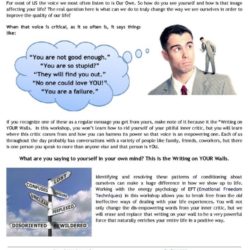
What’s really going on is that you are putting up barriers to your success in your mind and you keep bumping into them and you’re not certain how to navigate these barriers. These barriers are what we call the writing on your wall that tells you what you are capable of. The inner critic might tell you that you aren’t really that kind of person that could accomplish this thing that you’re attempting. The words may sound more like you’re not deserving, not good enough, not smart enough, to young or to old and a host of other things.
This is All Stuff of the Mind
Most of your programming of the mind is NOT TRUE. They are someone else’s ideas and beliefs of what you should and shouldn’t do. This programming was written on your walls between the ages of 0 to 8 by well meaning others who were also programmed back through time. The others, who in most cases, were your early care caregivers, lived and made their choices and set their beliefs under a different set of circumstances. You were told things that related to their generation, whether these were political, social, religious, or related to cultures of that time and the environment they lived it. This is not the environment that you live in today, many of these beliefs are not yours and of course many things have changed since then and yet because they were programmed in your mind you automatically and dutifully allow them to control your life.
Check in with Your Thought Habits
There are times you make some headway in the direction you want to go before you start to sabotage yourself at the first signs of your obstacles. Once again, the critic is trying to keep you in a place that is familiar for you. It feels “normal” to dwell on problems and swim around in a sea of negativity. But this is a thought habit.
You may reflexively and habitually dwell on problems instead of refocusing your mind on something more useful. But you can also make a different choice, you can begin to understand your programming through self discover processes and you can even rewrite the writing on your wall with the beliefs that serve you well in your life in present time. Without the inner critic reiterating the old negative stuff, you can build a new habit of learning to gain more and more control of where you put your focus.
Reality check your beliefs; give yourself approval and allow yourself to be who you want to be.
Stop seeking others approval and stop listening to the inner critic. Know what it is that you believe, know yourself and your patterns, accept and honor yourself and in doing so your direction up the mountain will become clear and it will come from an empowered you.
So many limitations are mostly in our minds. To dissolve the inner barriers or let go of any self-sabotaging tendencies is no easy task and it can take time. The use of Self-discovery and Energy Technology processes such as Emotional Freedom Technique (EFT) will help you erase and replace this old programming and you will be free of the barriers that may have held you prisoner for so long. There is no need to settle for mediocrity. Most average people give up as soon as things get tough and then they complain that they never got what they wanted.
May you become the person everyone goes to if they want something handled that is too hard …. and may you begin with you!
…..love and light, Christina
More Content on Never Settling

The post No Need to Settle for Mediocrity appeared first on Eudaimonia Center.
]]>